Showing posts with label Jamie Ford. Show all posts

Thursday, September 1, 2022

Julie's Review: The Many Daughters of Afong Moy

Author: Jamie Ford
Series: None
Publication Date:  August 2, 2022
Publisher: Atria Books
Pages: 384
Obtained: publisher via NetGalley, BOTM
Genre:  Literary Fiction
Rating: 5/5
Bottom Line: Complex story about what we carry with us through generations
Grab, Just get it at the library, or Remove from your TBR list? Grab

Summary: Dorothy Moy breaks her own heart for a living. As Washington’s former poet laureate, that’s how she describes channeling her dissociative episodes and mental health struggles into her art. But when her five-year-old daughter exhibits similar behavior and begins remembering things from the lives of their ancestors, Dorothy believes the past has truly come to haunt her. Fearing that her child is predestined to endure the same debilitating depression that has marked her own life, Dorothy seeks radical help. Through an experimental treatment designed to mitigate inherited trauma, Dorothy intimately connects with past generations of women in her family: Faye Moy, a nurse in China serving with the Flying Tigers; Zoe Moy, a student in England at a famous school with no rules; Lai King Moy, a girl quarantined in San Francisco during a plague epidemic; Greta Moy, a tech executive with a unique dating app; and Afong Moy, the first Chinese woman to set foot in America. As painful recollections affect her present life, Dorothy discovers that trauma isn’t the only thing she’s inherited. A stranger is searching for her in each time period. A stranger who’s loved her through all of her genetic memories. Dorothy endeavors to break the cycle of pain and abandonment, to finally find peace for her daughter, and gain the love that has long been waiting, knowing she may pay the ultimate price. ~amazon.com

Review: I have been a fan of Jamie Ford and his books since Hotel on the Corner of Bitter and Sweet but the complexity of this one knocks all his others off the shelf. I can’t imagine the research that went into understanding the historical parts, writing the future and epigenetics.

Mr. Ford tells the story of the Moy women through various trials over decades and centuries. How each of them inherited the history of the person before them in their present. Afong Moy, the first of the Moy women is a spectacle in the late 1800s as she's paraded around from city to city as being "The First Chinese Woman in America." Her heartache and pain transfer to the next generation and so forth and so on, until we get to Dorothy Moy. Dorothy is not a happy women, other than her daughter Annabelle, nothing much brings her joy. She has struggled with her mental health all her life and a new treatment looks promising to help her finally work through her issues. 

We get flashbacks to the other Moy women: Lai-King, Faye, Zoe, Greta  and a flashforward to Annabelle. Mr. Ford provides us with enough of their stories that make you want more but doesn't flush them all out because they would each be their own novella. What he did so well was visit each of them through Dorothy at the end of the book which I thought was brilliant. 

The story of the Moy women is one of survival, loss, love and hope. It is how we carry the pain of the past into the present but hope for better in the future. There is a lot to unpack in this novel and it'll be a bit before I let these characters go. It would make a fantastic book club choice, so much to discuss. 

Share/Bookmark

Monday, November 6, 2017

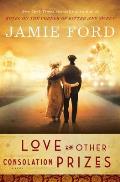
Julie's Review: Love and Other Consolation Prizes


Author: Jamie Ford
Series: None
Publication Date: September 12, 2016
Publisher: Ballatine
Pages: 320
Obtained: publisher via NetGalley
Genre:  Historical Fiction
Rating: 4/5
Bottom Line: Another winner from Mr. Ford about finding your place in the world no matter your start
Grab, Just get it at the library, or Remove from your TBR list? Grab or Library
Summary: For twelve-year-old Ernest Young, a charity student at a boarding school, the chance to go to the World’s Fair feels like a gift. But only once he’s there, amid the exotic exhibits, fireworks, and Ferris wheels, does he discover that he is the one who is actually the prize. The half-Chinese orphan is astounded to learn he will be raffled off—a healthy boy “to a good home.” The winning ticket belongs to the flamboyant madam of a high-class brothel, famous for educating her girls. There, Ernest becomes the new houseboy and befriends Maisie, the madam’s precocious daughter, and a bold scullery maid named Fahn. Their friendship and affection form the first real family Ernest has ever known—and against all odds, this new sporting life gives him the sense of home he’s always desired. But as the grande dame succumbs to an occupational hazard and their world of finery begins to crumble, all three must grapple with hope, ambition, and first love. Fifty years later, in the shadow of Seattle’s second World’s Fair, Ernest struggles to help his ailing wife reconcile who she once was with who she wanted to be, while trying to keep family secrets hidden from their grown-up daughters. Against a rich backdrop of post-Victorian vice, suffrage, and celebration, Love and Other Consolations is an enchanting tale about innocence and devotion—in a world where everything, and everyone, is for sale. ~amazon.com

 Review: Love & Other Consolation Prizes  covered a part of history that I wasn't aware of and I love when books do that. It is amazing that even in the early 1900s people were sold to be servants but I guess I shouldn't be so shocked. Ernest was an orphan after coming over from China and ends up in a home for boys with a benefactor who decides to auction him off  to the highest bidder during the 1909 AYP World's Fair. While the benefactor might not have been enthusiastic about the fact that the highest bidder was a Madam, it turned out to be the best thing for Ernest. It seems his destiny was set in motion on that boat from China.

As Ernest gets settled at Madam Flora's he learns where he's living and how they make their living. It is also where he falls in love with two very different girls but yet very similar. Both of them also love Ernest is a very true and pure sense. Both girls are destined to be strong women who succeed in what they do but one needs Ernest more than the other. I enjoyed that Ernest told his story to his daughter, JuJu, because she was researching the previous world's fair and found out that he had been the young man that was auctioned off. He was hesitant to tell his story because of the way it intertwined with their mother, Gracious. Gracious is in failing health and her memories come and go, she doesn't always remember Ernest but ever since JuJu mentioned the world's fair, she's been talking more about the past.

While most of the story was a bit predictable there were a couple twists and turns that I didn't see coming. I enjoyed the symbiotic relationship between Fahn, Maisie and Ernest. I'm fairly certain both girls knew the other one was in love with Ernest but they didn't fight over him and they didn't let it get in the way of their friendship.

I appreciate the amount of detail that Mr. Ford goes into for both time periods. Especially in earlier parts of the novel it felt that you were really there. I could hear the sounds and could picture the brothel. I could see the spectacles that Madam Flora put on for her clientele. Any author who can transport you to another time period, is well worth reading. Love & Other Consolation Prizes is well worth the read.

 Share/BookmarkGoogle+

Thursday, September 5, 2013

Julie's Review: Songs of Willow Frost

Summary: From Jamie Ford, the New York Times bestselling author of the beloved Hotel on the Corner of Bitter and Sweet, comes a much-anticipated second novel. Set against the backdrop of Depression-era Seattle, Songs of Willow Frost is a powerful tale of two souls—a boy with dreams for his future and a woman escaping her haunted past—both seeking love, hope, and forgiveness. Twelve-year-old William Eng, a Chinese American boy, has lived at Seattle’s Sacred Heart Orphanage ever since his mother’s listless body was carried away from their small apartment five years ago. On his birthday—or rather, the day the nuns designate as his birthday—William and the other orphans are taken to the historical Moore Theatre, where William glimpses an actress on the silver screen who goes by the name of Willow Frost. Struck by her features, William is convinced that the movie star is his mother, Liu Song. Determined to find Willow and prove that his mother is still alive, William escapes from Sacred Heart with his friend Charlotte. The pair navigate the streets of Seattle, where they must not only survive but confront the mysteries of William’s past and his connection to the exotic film star. The story of Willow Frost, however, is far more complicated than the Hollywood fantasy William sees onscreen. Shifting between the Great Depression and the 1920s, Songs of Willow Frost takes readers on an emotional journey of discovery. Jamie Ford’s sweeping novel will resonate with anyone who has ever longed for the comforts of family and a place to call home. ~powells.com  

Review:  I've been waiting and waiting for Jamie Ford to come out with another novel. Hotel on the Corner of Bitter and Sweet is one of my favorite books ever. I had high hopes for Songs of Willow Frost and I wasn't disappointed. Mr. Ford has a way of simply and beautifully telling a story.

Songs of Willow Frost is a story of loss, love and hope. It is heart-wrenching to have William find his way back to his ah-ma only to be taken back to the orphanage. We learn about Liu Song through her telling William his family's story. Liu didn't have an easy life and experienced heartbreak may times in her life. It is when she meets Colin Kwan that her life changes. He introduces her to performing on stage and on the screen. She doesn't know a way out of the life of poverty that her and William are living. Liu is an interesting character because in the beginning I felt like she was selfish and self-absorbed but after hearing her story I realized that she had no other option than the one she chose.

While Sister Briganti might have seemed harsh at times, she was really trying to protect William from getting his heartbroken all over again. She was looking out for his best interest even if he didn't think she knew what was best for him. William's friend Charlotte was his emotions when he was her eyes. There's was a friendship that perhaps was destined for more.

Mr. Ford also gives us background on the flourishing motion picture business in Seattle before everything was centralized in Hollywood. It is also through this subplot that we are smacked in the face with the bigotry/racism towards Chinese-Americans. How even when filming a Chinese movie or performing a play they had white actors play those parts. I am again reminded how racism isn't just towards black but of anyone who looks different than the majority. Our history, at times, isn't pleasant.

Mr. Ford excels at storytelling and how he reveals the back story. I loved the dual time periods because they weren't decades apart and were the beginning and middle of the same story. They didn't need intersecting because they were continuous.

Final Take: 4.75/5

Songs of Willow Frost will be released on 9/10/2013 by Ballantine Books.

 Share/BookmarkGoogle+

Thursday, May 28, 2009

Author Interview: Jamie Ford

I'm so excited that Jamie Ford was able to answer some questions regarding Hotel on the Corner of Bitter and Sweet for me. The book was truly remarkable and I look forward to his next book!! BEWARE: Possibly contains spoilers

GJR: I always hear that you should "write what you know" when you are doing your first novel, given that statement what part of the story is yours? Was it born out of historical research or family history?

Jamie Ford: Hmmm…I prefer to turn that maxim around and say, “Know what you write.” So there was a ton of historical research, which I love, but––confession time––there is also a lot of my own familial turmoil in the book. Not in an autobiographical way, per se, but more as it relates to the emotional content. There’s a little bit of my own story in there, as well as my father’s and my grandfather’s. They say that writers need to prick their fingers and bleed on the page––if that’s true then this story is more of a heart transplant.

GJR: What made you decide to write the chapters in the present, 1986 and the past, mid 1940s? Did you feel that it would perpetuate the story better if we read it from Henry's point of view? I wonder how different the story would be from Keiko's point of view. Was that considered?

JF: Well, I really wanted to give the story a redemptive ending, which is a literary way of saying, “And they lived happily ever after.” But I just couldn’t find that ending in the 40s. Because when Japanese families returned from internment, it wasn’t a happy ending, it was more like quiet relief. Jumping to the 80s allowed for the dust to settle, for families to rebuild lives, and for old wounds to heal a bit.

As far as Keiko’s point of view, I did consider that, but since I’m half Chinese, I felt more comfortable telling the story through that lens.

GJR: I loved the ending. In fact, I was at lunch reading it and crying. Why did you decide to give the readers the ending we were looking for? Was it also the ending you felt Henry and Keiko deserved?

JF: When I write, I feel like I’m either banking of spending emotional currency––I’m either tormenting my characters, or giving them relief, even joy. By that point in the story, I’d built up a lot of angst and it was time for an emotional payoff, so to speak.

Plus, as a reader, I’m not a fan of ambiguous, metaphorical endings. I always feel cheated. I loved No Country of Old Men, but the ending, not so much.

GJR: It's been many years since I've studied WW II and I'm almost positive the camps for the Japanese American's was not touched or barely touched in class. Why did you decide to center your book on this point of American history?

JF: My father wore one of the “I Am Chinese,” buttons mentioned in the book. That was really the genesis of the story––the tension between Chinese and Japanese communities that’s relatively unknown to Caucasian audiences. I knew I wanted to craft a bit of a noble romantic tragedy and those two communities became my Capulets and Montagues, but with fewer codpieces and rapiers.

GJR: Besides Keiko and Henry, my favorite relationship in the book was between Henry and his father. Do you think that Henry turned into his father in some ways with his own son Marty? Even though Henry and his father were both Chinese, I feel that their differences could be any ethnicity where the immigrant family wants their American born child (ren) to be American but yet respect the culture of the parents. Did you intentionally write Henry's father as a Chinese Nationalist or did that come about when fleshing out the story?

JF: This is one of those areas where the history of Seattle’s Chinatown really infected some of the characters–-like Henry’s father, who Henry ends up mirroring in some ways.

When I was doing my research and found a mention of Dr. Sun Yat-sen coming to Seattle to raise money for the war back in China, I immediately envisioned Henry’s father as the type of loyalist that would be behind that movement––that kind of nationalist fervor. It created a rich, and historically accurate mindset to contrast Henry’s modern, American ways.

GJR: Is Sheldon based on a real person who played with Oscar Holden or a portrait of different people you met during your research? I loved how you weaved Jazz into the story; it was such an important musical movement during that period of time. Did you feel that it key to Henry and Keiko's story?

JF: When I was rendering Henry and Keiko’s world it felt false to not include the jazz clubs and great characters like Oscar Holden, who was a real person. Sheldon though, is more of an amalgam of musicians that were working in the clubs of South Jackson at the time. Those clubs were such a part of the tapestry of the neighborhood––they needed to be included. Plus, it’s always good to remind people that there’s more to Seattle jazz than Kenny G.

GJR: You left me wanting more, is there any chance we'll meet Henry and Keiko again?

JF: I’m not sure, honestly. I still plan to write the story of Henry’s four years in China, so you might see him again, but I never planned for Keiko to be a part of that.

I’ve had so many emails asking for a sequel. I’d never revisit their story for financial reasons, but if there’s a natural extension––a story that’s dying to be told, I might consider it.

GJR: Hotel on the Corner of Bitter and Sweet is your first novel but you've written countless short stories. Are there any plans for publishing those? Would any of them be the great start of a novel?

I think the best short stories are ones with novel-length potential, so who knows? I am working on a special collection of short stories featuring the “other” characters in Hotel––Sheldon, Mrs. Beatty, Mr. Okabe, Henry’s parents, etc. All set in the same time period. If there’s interest, maybe it’ll see the light of day. If not, maybe it’ll just appear on my website.

GJR: Are you working on your 2nd novel? If so, what is the premise?

JF: The new book is about a failed kamikaze pilot, now in his 70s, who is still searching for a noble death, one that will allow his spirit to be reunited with that of his late wife. It’s another historical love story.

GJR: What has been most interesting aspect of having your book published and on the best seller list?

JF: Well, aside from the bodyguards, the limousines, and the private jet, it’s pretty much same ‘ol same ol’. Oh, and Paris Hilton, if you’re reading this, I’m just not that into you.

I want say a huge Thank You to Jamie Ford for taking the time to answer my questions!

Wednesday, May 27, 2009

Julie's Review: Hotel on the Corner of Bitter and Sweet

Summary: In the opening pages of Jamie Ford’s stunning debut novel, Hotel on the Corner of Bitter and Sweet, Henry Lee comes upon a crowd gathered outside the Panama Hotel, once the gateway to Seattle’s Japantown. It has been boarded up for decades, but now the new owner has made an incredible discovery: the belongings of Japanese families, left when they were rounded up and sent to internment camps during World War II. As Henry looks on, the owner opens a Japanese parasol.This simple act takes old Henry Lee back to the 1940s, at the height of the war, when young Henry’s world is a jumble of confusion and excitement, and to his father, who is obsessed with the war in China and having Henry grow up American. While “scholarshipping” at the exclusive Rainier Elementary, where the white kids ignore him, Henry meets Keiko Okabe, a young Japanese American student. Amid the chaos of blackouts, curfews, and FBI raids, Henry and Keiko forge a bond of friendship–and innocent love–that transcends the long-standing prejudices of their Old World ancestors. And after Keiko and her family are swept up in the evacuations to the internment camps, she and Henry are left only with the hope that the war will end, and that their promise to each other will be kept.Forty years later, Henry Lee is certain that the parasol belonged to Keiko. In the hotel’s dark dusty basement he begins looking for signs of the Okabe family’s belongings and for a long-lost object whose value he cannot begin to measure. Now a widower, Henry is still trying to find his voice–words that might explain the actions of his nationalistic father; words that might bridge the gap between him and his modern, Chinese American son; words that might help him confront the choices he made many years ago. Set during one of the most conflicted and volatile times in American history, Hotel on the Corner of Bitter and Sweet is an extraordinary story of commitment and enduring hope. In Henry and Keiko, Jamie Ford has created an unforgettable duo whose story teaches us of the power of forgiveness and the human heart. ~ballantinebooks.com
Review: I love stories that cross generations and time periods, so it really should come as no surprise that I adored Hotel on the Corner of Bitter and Sweet: A Novel. This beautifully written story is about love, family, growing up and finding what you've missed the most in life. I had been eyeing this book from Amazon and all over the blogosphere so when Tracee from Pump Up Your Book Promotion contacted me about doing a review and author Q&A, I was thrilled!!! Let's just say that all the hype around this book is well deserved. I loved the point of view the story was told from, Henry's and I thoroughly enjoyed how it went back and forth between the 1940s and the 1980s. I like how we get to know Henry when he's older and reflecting on his life. This very much reminded me of how Water for Elephants: A Novel and The House at Riverton: A Novel were told. I think in telling a story from this perspective it lends itself to being introspective as well as retrospective.

Henry from the get go is a very likable character. You immediately feel for him even if you've never had the same experiences as him. All of us at one point in our lives has felt like an outsider. Really, that's what Henry is, both at school and at home. Then he meets Keiko, a young Japanese American and almost immediately feels at home with her. They begin a very strong and lasting friendship. I was also taken in very quickly by Keiko. Their friendship is cemented the night they decide to go to the Black Elks Club to listen to Jazz music. Their experience there defines them for the rest of their lives.

In a part of American history that is not written about or discussed that often, the Japanese families are rounded up and taken to interment camps. This is under the guise of their own safety but I'm sure the US government had other agendas in mind. Of course Keiko and her family are taken to Camp Harmony and his destroys Henry. He can't think of anything else and ends up damaging his relationship with his parents. I believe this is the pivotal point in the story; this is where Henry becomes a man.

I can't really say too much more about the story without giving it away but I will say that not only are the main characters likable but almost all of the supporting characters give a great deal to the story. One of my favorite dynamics is between Henry and his father. What a struggle to be caught between two worlds! Henry's father wants him to be American but yet wants him to be Chinese. While I can't personally relate to this, I can imagine that it was this way for a lot of immigrant families who's children were the first generation to be born in America.

While there isn't a single scene that stands out, besides perhaps the ending to me, its how the story flows and unfolds that kept me entranced. I highly recommend this book for anyone who is interested in a part of American history that isn't talked about. It's also a beautiful love story.

Final Take: 5/5